Chinese
 English
What this article covers: What is a “granny flat arrangement” (and what is a “granny flat interest”) Why “handshakes” fail: common risk factors Why wording matters (and what to avoid) How the Family Court treats granny flat arrangements if separation occurs...
消息
Other News
Unfair Terms in Consumer and Small Business Contracts
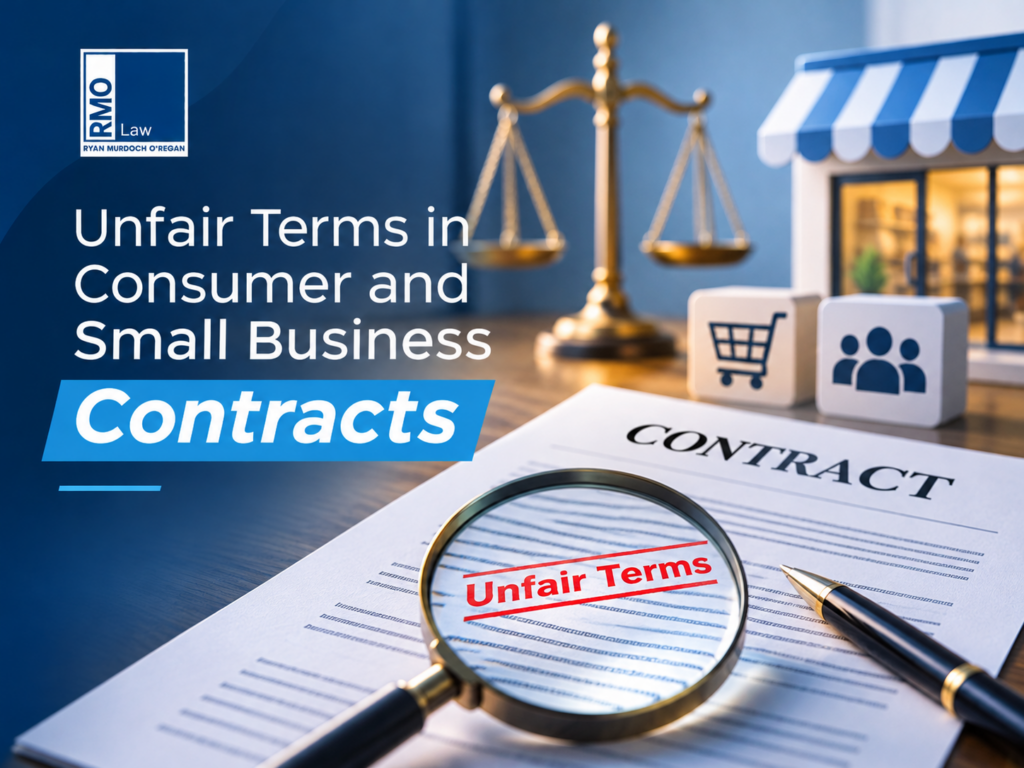
The Australian Consumer Law (ACL) s. 24 makes provision for a party to that contract to declare or state that a term of the contract or terms is or are unfair within the meaning of the ACL. This applies to consumer contracts or small business contracts.
A consumer contract is one in which a contract is for supply of goods or services or a sale or grant of an interest in land to an individual wholly for the personal domestic or household use or consumption.
A small business contract however is one which is also for the supply of goods or services or a sale of grant or interest in land but at least one of the parties (usually the party claiming unfair terms) makes the contract the course of carrying on a business at a time when the party employs fewer than 100 persons or that parties turnover for the last income financial year was less than 10 million dollars.
The contract must also be what is called a “standard form contract” which is not specifically defined. However, if a party or proceeding alleges that a contract is a standard form contract it is presumed to be a standard form contract unless the other parties in the proceeding proves otherwise. In determining whether the contract is a standard form contract court may take into account various matters. In general it takes into account whether one party has most of the bargaining power and in particular whether the contract was one that was in existence prior to any negotiations of entry into the contract and if one party does not really have an effective opportunity to negotiate the terms of the contract (the contract was presented as “take it or leave it”). An obvious example of that would be standard terms and conditions that are standard to be included in the terms of the contract when one is invoiced for such delivery of goods.
It is also important to note that if the contract is a financial contract then there are single provisions under other Commonwealth legislation and cast in the same terms.
What is unfair?
To be regarded as unfair the term or terms complained of must satisfy three criteria;
- It will cause a significant imbalance of the parties rights and obligations arising under the contract;
- It is not reasonably necessary in order to protect the legitimate interest of the party who would be advantaged by the term;
- It would cause detriment (with a financial or otherwise to a party if it were to be applied or relied on).
However simply because it provides for some claim for damages or penalties if the consumer party breaches the contract does not necessarily make it unfair. To determine whether it is unfair Section 25 of the ACL provides some examples (without dividing what is unfair) of unfair terms.
Without going into particularity of Section 25 it is said that generally what is looked at if the contract is waited more in favour of one party (usually the supplier) without the consumer having an equivalent right or whether it imposes terms that are a detriment to the consumer which are not reasonable. Also, if the contract only permits the (usually the supplier) the right to determine the contract has been breached or to vary the contract or whether it should remedy any breach by it.
In making this determination the court would take into account how the terms complained of work within the whole context of the contract.
Other criteria is that the term must still be “transparent” meaning;
(a) expressed in reasonable plain language;
(b) legible (not the extreme fine print that sometimes occurs; and
(c) presented clearly i.e obviously seen as a term and an idea readily available by any party effected by the term.
In respect of business contracts a party if they claim a term or terms are unfair if the contract was entered into on or after 9 November 2023, or the contract was renewed or the particular term or terms complained of were inserted on or after that date.
It can be seen that the above can be a powerful weapon in response to what may be unreasonable pressure or claims made by the supplier of goods or services or supplier of finance in relation to a contract entered into on or after 9 November 203. However, as seen from the above there are many factors to be considered whether in fact the term is unfair. Accordingly, it would be prudent to seek legal advice before embarking on the term or terms are unfair.
It is also to be noted that even if a term or terms are regarded as unfair the rest of the contract is still valid and operates without the unfair terms.
RMO Law can provide you with clear, precise advice if you are concerned about unfair terms in a contract.
This article is for your information and interest only. It is not intended to be comprehensive, and it does not constitute and must not be relied on as legal advice. You must seek specific advice tailored to your circumstances.
Article authorised by 罗利·奥雷根
Get in Touch